
For about 60 years, the Eagle Trace golf course has been the heart of this Broomfield neighborhood. It started as the 9-hole Broomfield Country Club in the early 1960s and became today’s 18-hole course, designed by Dick Phelps and built in 1982–83, with five large lakes and mature cottonwoods. That’s about to change.
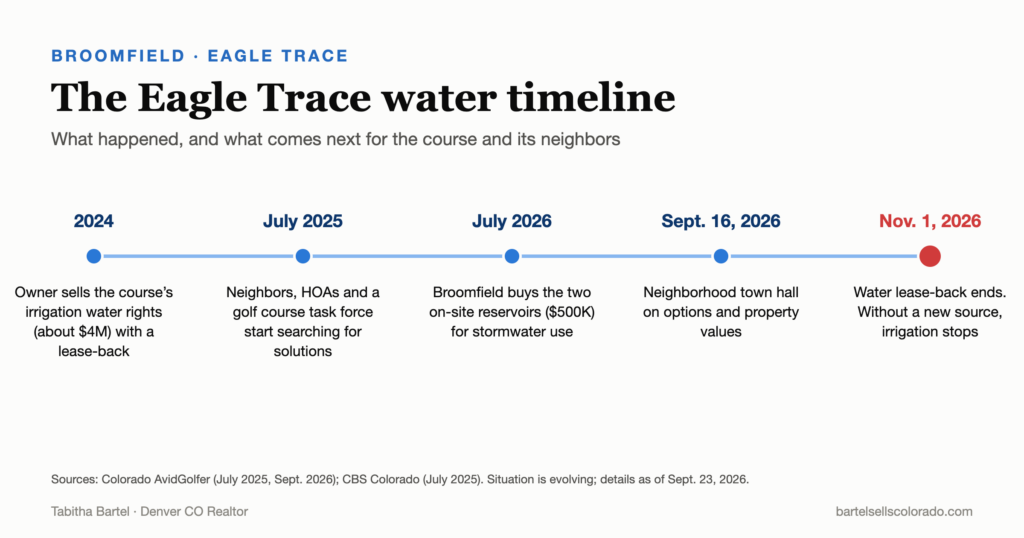
According to the Eagle Trace Community Development Corporation (CDC), the course’s current operators will stop maintenance and operations in November 2026, when the course’s irrigation water runs out. The water lease is set to end on November 1.
As a Broomfield resident (since 2005) I’ve had a lot of questions from neighbors about what this means for their homes. Here’s what we know, what’s still unknown, and what it means for homeowners, sellers, buyers, and Broomfield as a whole.
What’s Happening at the Eagle Trace Golf Course?
The Eagle Trace golf course (officially Eagle Trace Golf Club) sits near 10th Avenue and Main Street, across from Broomfield High School, and is surrounded by several neighborhoods and HOAs, with roughly 500 homes nearby. Here’s how we got here:
- The water was sold. In 2024 the owners sold the course’s irrigation water rights, which date back to 1889, for about $4 million. The deal included a lease-back so the course could keep using the water for a while. According to the CDC, those original water shares can’t be bought back.
- The lease-back ends November 1, 2026, and the water is set to go to a development in Lafayette.
- The owner wants to sell. The CDC says the current owner is interested in selling. But without water, the course “has little value to any potential investor as a golf course.”
- Keeping it a golf course would be expensive. The CDC estimates $3 to $5 million in deferred maintenance, before any major layout changes. The property may have rights to drill two wells for irrigation, which could be part of a long-term solution.
What Is the City Doing?
The City and County of Broomfield has been involved, but it has limits:
- Water and reservoirs: In July 2026, Broomfield completed a water purchase tied to the course’s reservoirs. Colorado AvidGolfer reports it was about $500,000, mainly for stormwater management. Nissen Reservoir holds stormwater from the neighborhoods north of it. The CDC also says the city is negotiating for Clear Creek water rights and an easement to Nissen Reservoir to help keep irrigation, lakes, and ponds going.
- No immediate funding: The city says it doesn’t have funding set aside to fix the Eagle Trace situation. City staff estimated that buying enough water to keep the full course green would cost $1.5 to $2 million, and recommended against the city running a golf course.
- A long timeline: If the property is abandoned or ends up owned by the city, staff estimate it could take 5 to 8 years to decide on uses, find funding, and carry out a plan.
- Council involvement: Council members from Wards 3 and 4 have been taking part in the neighborhood task force meetings.
Can the Eagle Trace Golf Course Land Be Developed?
This is the first question most homeowners ask. The land is zoned as a Planned Unit Development (PUD) with the course designated as open space for golf course use, and Broomfield’s open lands plan also treats it as open space. Any other use would require a rezoning process, with public hearings and a City Council vote.
The CDC also notes that the neighborhood’s original property plan has 94 single-family units that were never built. That’s one reason residents want a real voice in what happens next.
In the near term, the most likely scenario is a course that’s no longer irrigated or maintained. That’s what happened at Deer Creek Golf Club in Littleton, which went back to native vegetation after its owner sold its water rights in 2023.
The Eagle Trace Community Development Corporation
Neighbors have organized. The Eagle Trace Community Development Corporation is an all-volunteer nonprofit created by residents to plan for the property’s future and protect the neighborhood’s green space, property values, and character.
The CDC can accept tax-deductible donations of cash, real estate, or other assets. It was set up in part so it could hold the golf course property if the owner decides to donate it. That would give the community a lot of influence over how the land is owned, used, and run.
The CDC is looking at five possible uses:
- Keep it a golf course, with a plan to improve conditions and cut operating costs
- A community park with turf areas, play equipment, and walking trails
- Native open land with turf replaced by native plants and trails
- A botanical garden on part of the property, with gardens, trails, and event space
- Mixed use, combining several of these
Make your voice heard: The CDC’s community survey on the property’s future is open through Monday, September 28, 2026. If you live nearby, this is one of the best ways to shape what happens next. You can also volunteer or donate through eagletracecdc.org.
What This Means for Homeowners
- Expect some uncertainty in values. The CDC itself expects surrounding property values to decline significantly during this uncertain period. National estimates put the drop for homes next to closed golf courses at roughly 10% to 30%, but it depends heavily on what the land becomes. Well-kept parks, trails, or open space can hold value far better than land left to go to weeds.
- The land’s future matters more than the shutoff. The survey, the CDC, your HOA, and City Council are where that gets decided. Get involved.
- Plan for a long timeline. If this ends up in the city’s hands, it could take 5 to 10 years to resolve. Make decisions based on your own plans, not on waiting for a quick fix because there definitely isn’t one.
- Keep your home looking its best. If the view behind you changes, curb appeal and upkeep matter even more.
- Watch your HOA. Ask whether any assessments or contributions tied to the course are being discussed and what this means for you as a homeowner.
What This Means for Sellers
- You need to disclose it. Colorado sellers must disclose known issues that affect a property, and the HOAs around Eagle Trace have already said this falls into that category. Being upfront builds trust and protects you. Talk with your agent, and an attorney if you have questions, about the exact wording.
- Timing matters. The course is still a course and being somewhat maintained. Listing before maintenance stops lets buyers see your home at its best, though you still need to disclose. If you were planning to sell in the next year or two anyway, it’s worth weighing that against waiting out a long, uncertain period.
- Price realistically. Buyers will factor in the uncertainty. With more than half of Denver-area listings taking price cuts this fall, pricing it right the first time is critical.
- Sell the whole neighborhood, not just the view. Eagle Trace still has a lot going for it: a central Broomfield location, quick access to US-36 between Denver and Boulder, nearby schools and parks, and established neighborhoods.
- Consider concessions. A seller-paid interest rate buydown can bring in more buyers than an equal price cut and can offset some of the uncertainty.
What This Means for Buyers
- Uncertainty can mean opportunity. Some sellers will be motivated, and you may be able to negotiate a better price or seller concessions.
- Don’t pay a “golf course lot” premium for a fairway view that may not look the same next year.
- Do your homework. Read the seller’s disclosure, HOA documents and minutes, and the CDC’s updates. Ask about possible HOA assessments. Have an attorney look over HOA docs to read through anything you could potentially miss.
- Think long term. If the land becomes a park, trails, or managed open space, homes backing to it could stay very desirable, and buying during the uncertainty could pay off for buyers who plan to stay.
What It Means for Broomfield
Eagle Trace is part of a bigger Colorado story. Water is expensive, and older golf courses are increasingly selling off their water rights. A course that has served Broomfield for six decades could become a park, trails, a botanical garden, or a better-run golf course, or it could be left to decline. Which way it goes depends on the owners, the city, and how involved the community stays.
The Bottom Line on the Eagle Trace Golf Course
The Eagle Trace golf course shutdown is a real change for this part of Broomfield, but the long-term impact on homes depends on what happens to the land next. If you live nearby, take the CDC survey before September 28. And whether you’re thinking about selling, looking to buy, or just want to know how this affects your home’s value, I’m happy to walk you through the numbers for your property.
Explore Broomfield: Broomfield homes & neighborhood guide
Wondering what your home is worth? Request a free home valuation
Questions? Contact Tabitha
This situation is changing quickly. Details are current as of September 23, 2026. Sources: Eagle Trace Community Development Corporation (eagletracecdc.org); Colorado AvidGolfer (July 15, 2025 and September 15, 2026); CBS Colorado (July 23, 2025). This post is general information, not legal advice. Talk with a real estate attorney about your specific disclosure obligations. Tabitha Bartel is not affiliated with the Eagle Trace CDC.
Leave a Reply